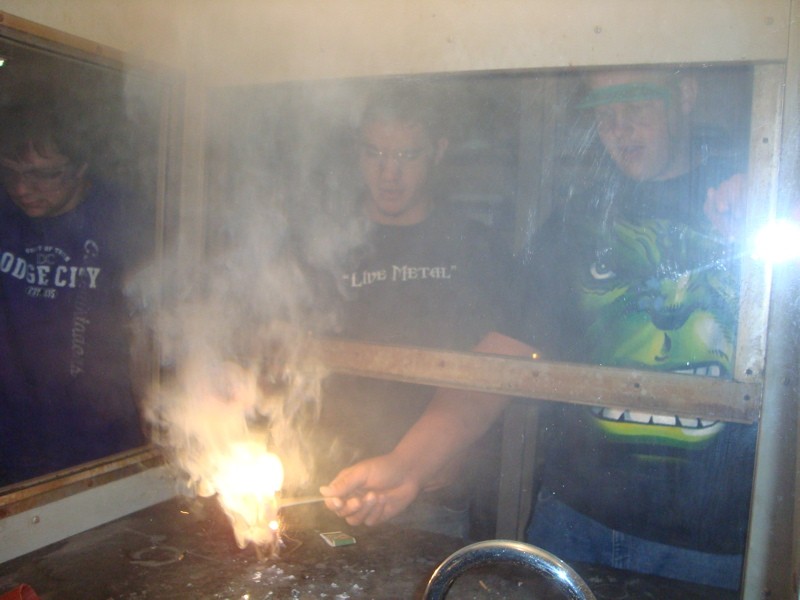
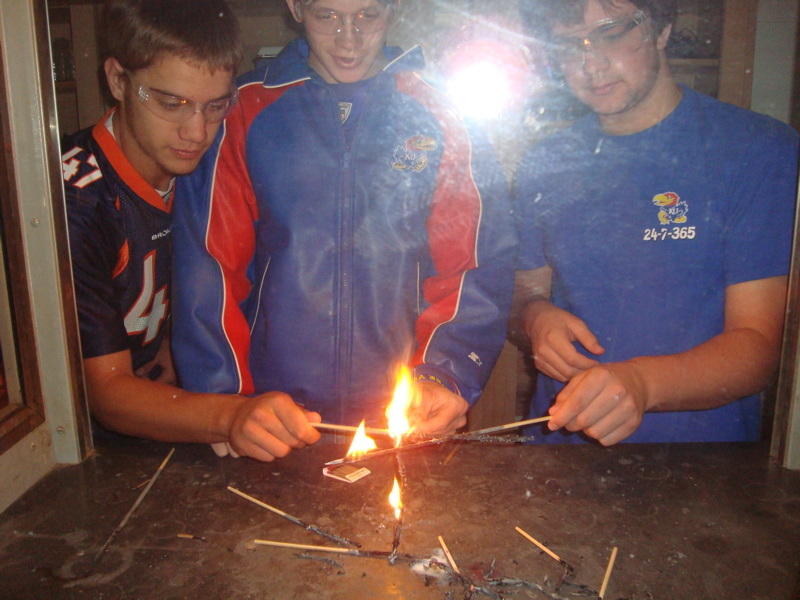
Chem II students light sparklers they made while studying how excited electrons can emit different colors of light. You
are seeing the color here due to the combustion reaction occurring when
the sparklers are lit. The heat from the fire and the combustion in
general are causing the electrons to move into the excited state. When
they move back into the ground state, they emit a photon of energy,
which is the color you are seeing.-Chem II Class Project
What exactly is a firework? an explosive that is used for entertainment purpose -Brock
Where and when were the first fireworks invented? China in the 2nd century -Micheal
Who were the first Europeans to master fireworks? Italians -Draveyn
| Color | Compound | Wavelength (nm) |
| * | red | strontium salts, lithium salts lithium carbonate, Li2CO3 = red strontium carbonate, SrCO3 = bright red | 652 |
| * | orange | calcium salts calcium chloride, CaCl2 | 668 |
| * | yellow | sodium salts sodium chloride, NaCl | 610-621 |
| * | green | barium compounds + chlorine producer barium chloride, BaCl2 | 589 |
bright green | Barium chloride BaCl2 | ||
| * | blue | copper compounds + chlorine producer copper acetoarsenite (Paris Green), Cu3As2O3Cu(C2H3O2)2 = blue | 505-535 |
| * | purple | mixture of strontium (red) and copper (blue) compounds | 420-460 |
| * | silver | burning aluminum, titanium, or magnesium |
|
turquoise | copper compounds + chlorine producer copper (I) chloride, CuCl = turquoise blue | ||
white | white-hot metal, such as magnesium or aluminum barium oxide, BaO | ||
pink | CaCO3, CaSO4, CaC2O4 |
